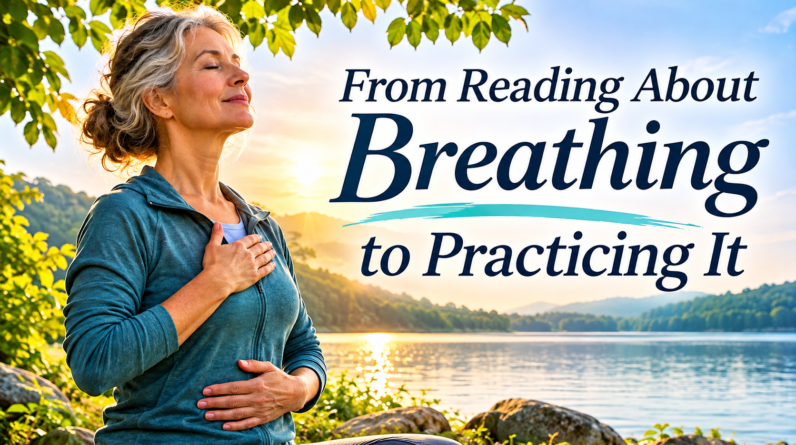
Have you ever read an article about breathing exercises, thought, “That sounds like something I should try,” and then moved on to something else?
Perhaps you’ve watched a video about mindful breathing. Maybe you’ve come across an explanation of how breathing can influence relaxation, tension, or our perception of discomfort. You found the information interesting, perhaps even encouraging.
But there’s a difference between knowing about a breathing technique and actually practicing it.
And that difference is what I’d like to explore today.
Over the years, through my experiences with Tai Chi, Qigong, choral singing, and teaching, I’ve developed a deep appreciation for the role breathing plays in our physical and mental awareness.
One thing I’ve come to appreciate is that breathing is something we can study endlessly, but its real value becomes much more meaningful when we begin paying attention to our own breath.
If you’ve been considering breathing exercises as part of a natural approach to pain management, perhaps this is the moment to move from reading to doing.
The Difference Between Reading About Breathing and Actually Breathing
Of course, we’re breathing all the time. We don’t need instructions to keep doing that.
But intentional breathing is something different.
When we practice a breathing exercise, we’re choosing to pay attention to an activity that ordinarily happens without much conscious thought.
We may notice the rhythm of the breath, the movement of the body, our posture, or the sensations that accompany inhaling and exhaling.
In Tai Chi and Qigong, this kind of awareness is an important part of the practice.
Breathing isn’t simply an isolated mechanical action. It becomes part of a larger experience involving movement, attention, and awareness.
That doesn’t mean every breathing exercise needs to be complicated. In fact, I believe there’s considerable value in beginning with something straightforward.
The challenge is often knowing where to begin.
You can certainly search online and find explanations of individual breathing techniques. There are articles, videos, and discussions covering a wide variety of approaches.
But eventually, you may reach a point where you’d rather stop collecting information and start exploring a few techniques for yourself.
That’s where having a structured guide can be helpful.
Why Breathing Exercises Interest Me as a Tai Chi and Qigong Instructor
My professional background might seem a little unusual for someone writing about breathing exercises.
I spent my career as a university music professor and arts administrator, and I hold a PhD in Music Theory from Indiana University.
Music has been an important part of my life for decades, particularly through choral singing and teaching.
And, of course, breathing is central to singing.
A singer learns to pay attention to the relationship between breath, posture, phrasing, and physical coordination.
In Tai Chi and Qigong, breathing takes on another dimension.
These practices encourage us to become more aware of the relationship between the body, the breath, and our attention.
My teaching certifications in Tai Chi and Qigong, together with my musical background and some experience with Yoga, have helped shape the way I approach breathwork.
I don’t view breathing exercises as mysterious techniques that require elaborate explanations before someone can begin.
I prefer to think of them as practices we can explore, experience, and gradually become more familiar with.
And when someone is interested in breathing as a possible complement to pain-management practices, I believe clear instruction is especially important.
What Does Breathing Have to Do With Pain Management?
Pain is a complex experience, and no single breathing technique should be presented as a cure for it.
There are many possible causes of pain, and appropriate medical evaluation and treatment remain important.
At the same time, breathing exercises offer a way to explore relaxation, attention, and body awareness.
When we’re uncomfortable, it can be useful to notice how we’re breathing, how we’re holding our bodies, and whether we’re carrying unnecessary tension.
A breathing practice gives us an opportunity to direct our attention toward these experiences.
For some people, breathing exercises may become a helpful part of a broader personal approach to managing discomfort and stress.
The important point is that breathing exercises are practices to explore, not promises of a particular medical result.
And the best way to understand what a technique involves is to learn it and try it appropriately.
Five Breathing Exercises, Five Different Purposes
With these ideas in mind, I created The Healing Breath: Five Essential Breathing Exercises for Natural Pain Relief.
It’s a 12-page digital guide designed to introduce five breathing techniques, each with its own emphasis.
Rather than presenting one exercise as the answer to every situation, I wanted to bring several approaches together in a single resource.
Here’s what you’ll find inside.
1. Pain-Relief Breath
This exercise uses a deep, focused breathing approach intended for exploring breath awareness in relation to discomfort.
It provides a starting point for someone specifically interested in breathing techniques as part of a pain-management practice.
2. Grounding
Grounding emphasizes calm and the release of tension.
It’s an opportunity to direct attention toward the present moment and explore a more settled state of awareness.
3. Energizing
Not every breathing exercise is focused exclusively on relaxation.
The Energizing exercise introduces an approach intended to support a sense of vitality and renewed energy.
4. Soothing
This technique emphasizes relaxation and inner calm.
It’s designed for moments when you want to explore a quieter, more peaceful breathing experience.
5. Restoration
Restoration focuses on reconnecting with inner calm and exploring a sense of balance.
Together, these five exercises provide different ways to approach intentional breathing.
You don’t need to assume that every exercise will feel the same or serve the same purpose.
The idea is to learn the techniques and become familiar with what each one involves.
Why I Included Video Demonstrations
One of the decisions I made when creating The Healing Breath was to include more than written instructions.
I believe written explanations are valuable. They allow us to review details, think about the sequence of an exercise, and return to particular instructions.
But when we’re learning a physical practice, seeing someone demonstrate it can be especially helpful.
That’s why each of the five exercises includes a link to a video demonstration and follow-along sequence.
You can read the instructions, watch the demonstration, and then follow along as you practice.
The guide also includes posture instructions, which are an important part of the approach.
This combination reflects something I’ve valued throughout my teaching career: different forms of instruction can reinforce one another.
Sometimes an explanation makes perfect sense on the page.
Other times, watching a demonstration helps clarify what the words are describing.
By providing both, I wanted to make the exercises more approachable for someone who is ready to begin.
You Don’t Need to Assemble Your Own Breathing Program
One of the appealing things about the internet is the enormous amount of information available to us.
But that abundance can also make it difficult to decide what to use.
You might find one breathing exercise in an article, another in a video, and a third in a discussion about relaxation.
There’s nothing inherently wrong with learning that way.
But if you’ve already decided that you’d like to explore breathing exercises, you may prefer having a small collection organized in one place.
That’s the practical idea behind The Healing Breath.
The guide brings together five exercises, their written instructions, posture guidance, and corresponding video links.
You can focus on learning the techniques rather than spending your time searching for the next explanation.
And because it’s a downloadable PDF, you don’t need a dedicated ebook reader.
You can access the document on a desktop computer, laptop, tablet, or smartphone, and use the included links to reach the demonstrations.
It’s a straightforward format for a straightforward purpose: helping you begin exploring intentional breathing.
A Practical Starting Point for $17
I wanted The Healing Breath to be a manageable introduction rather than an extensive textbook.
The complete guide is 12 pages long and includes all five exercises.
It’s available through Gumroad for $17 as a one-time purchase, with immediate digital download.
The product also includes a 14-day money-back guarantee.
What you’re purchasing is not a promise that breathing exercises will eliminate pain.
You’re purchasing an organized instructional resource that combines written explanations with demonstrations, so you can explore these practices for yourself.
For someone who has already decided to try breathing exercises, that may be exactly the kind of starting point they’re looking for.
From Curiosity to Practice
If there’s one thought I’d like you to take away from this article, it’s that you don’t have to keep reading about breathing exercises indefinitely.
At some point, you can choose a technique, learn how it’s performed, and begin exploring it.
You may discover that you enjoy a particular approach more than another.
You may find yourself becoming more attentive to your posture or the rhythm of your breathing.
Or you may simply appreciate taking time to engage in an intentional practice.
Whatever your experience, the important thing is to approach it with patience and curiosity.
That’s a perspective I value in Tai Chi, Qigong, music, and teaching.
And it’s the perspective I hope to share through The Healing Breath.
If you’re ready to move beyond reading about breathing exercises and begin learning five techniques for yourself, I invite you to explore the guide.
Get The Healing Breath: Five Essential Breathing Exercises for Natural Pain Relief — $17
You can download the PDF immediately and use the written instructions and linked video demonstrations to begin your exploration.
Sometimes the next step isn’t learning more about a practice.
It’s simply beginning.
Breathe mindfully,
Ralph Lorenz, PhD
Five Element Harmony
https://FiveElementHarmony.com
Note: This article and the accompanying guide are educational wellness resources. Breathing exercises are not substitutes for medical diagnosis, treatment, or professional care. If you have a medical condition or concerns about practicing breathing exercises, consult an appropriate healthcare professional.