Every Tai Chi Video Makes You Stand? Try This Instead
You search for Tai Chi because you want gentle movement.
Then the instructor says, “Now stand up.”
And there it is again.
You close another video because your body cannot follow it.
Maybe standing hurts after a few minutes.
Maybe your balance makes standing exercises feel unsafe.
Maybe you use a walker, cane, or wheelchair.
Or perhaps your legs simply tire much faster than before.
Yet you still want to move.
You still want the calm, flow, and focus Tai Chi offers.
Here is something many Tai Chi videos never tell you.
You can practice meaningful Tai Chi without standing for the whole session.
You can even practice while staying seated from beginning to end.
That does not mean pretending chair exercises are traditional standing Tai Chi.
It means taking Tai Chi principles and practicing them while seated.
That difference matters.
The Problem Is Not Your Interest in Tai Chi
You may have already tried several beginner Tai Chi videos.
The titles probably sounded perfect.
“Gentle Tai Chi for Beginners.”
“Easy Tai Chi for Seniors.”
“Tai Chi for Better Balance.”
Then five minutes later, everyone stands.
The instructor bends the knees and shifts weight between both feet.
Soon, you realize this “easy” routine still assumes something important.
It assumes you can stand comfortably.
That leaves many interested people watching instead of practicing.
You might even start blaming yourself.
Maybe Tai Chi just is not for you.
Maybe you waited too long to begin.
Maybe your body cannot do enough movement anymore.
Those conclusions miss the real problem.
The practice has not been adapted to fit your needs.
Think about music lessons.
A good teacher starts with what the student can play.
The teacher does not begin with the hardest piece available.
Tai Chi can work the same way.
Start with movement you can comfortably do today.
Then build your practice from there.
“But Is Seated Tai Chi Really Tai Chi?”
This question deserves a serious answer.
A skeptic might say seated Tai Chi misses the whole point.
Traditional Tai Chi uses standing postures and shifting body weight.
That is true.
Standing work plays an important role in traditional Tai Chi.
But that does not settle the question.
Tai Chi includes much more than standing.
Consider what happens during a simple Tai Chi movement.
You relax unnecessary tension.
You coordinate your arms and torso.
You breathe while moving slowly.
You guide each movement with your attention.
You move smoothly instead of rushing between positions.
You notice how one body part affects another.
You can practice all those skills while sitting.
Take a movement like Cloud Hands.
You can turn gently through your torso while seated.
Your arms can circle smoothly across your body.
Your eyes can follow the movement.
Your breathing can remain slow and comfortable.
Your attention can stay with each change.
You have removed the stepping.
You have not removed the entire practice.
That distinction changes everything.
You Do Not Need to Earn the Right to Participate
Here is where the issue becomes personal.
People with limited mobility already face enough closed doors.
Exercise should not become another one.
Yet fitness advice often starts with hidden assumptions.
Stand with your feet shoulder-width apart.
Walk for thirty minutes.
Get down onto the floor.
Hold this position while balancing on one leg.
Those instructions work well for many people.
They fail others before the exercise even begins.
Tai Chi should not become another locked door.
A chair can become your starting place instead.
You sit comfortably with your feet supported when possible.
You let your shoulders soften.
You allow your hands to rest.
Then you begin moving.
That first movement matters.
You are no longer watching someone else practice Tai Chi.
You are practicing.
That change can feel surprisingly powerful.
What Seated Tai Chi Can Actually Look Like
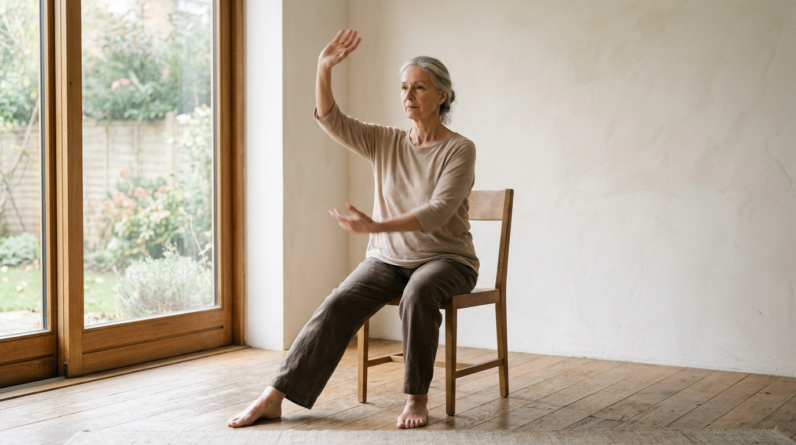
Imagine sitting in a sturdy chair.
Your feet rest comfortably on the floor.
You begin with your hands resting near your thighs.
Take one easy breath.
Now slowly raise both hands.
Let them float upward without forcing your shoulders.
Then slowly lower them.
That is simple.
But simple does not mean pointless.
Now add another layer.
Notice your shoulders as your hands rise.
Can they remain relaxed?
Notice your breathing.
Can you move without holding your breath?
Notice your hands.
Can they stay soft instead of becoming stiff?
Now gently turn your torso.
Let one hand travel across your body.
Return toward the center.
Then move toward the other side.
Suddenly, you have several things working together.
You have movement, breathing, awareness, and coordination.
That is far more than sitting and waving your arms.
You are training how your body moves as one connected system.
“I Tried Chair Tai Chi. It Felt Like Stretching.”
That can happen.
Not every exercise labeled “chair Tai Chi” teaches Tai Chi well.
Some routines simply move traditional exercises into a chair.
Others become basic stretching with a Tai Chi label.
The chair itself does not create Tai Chi.
How you practice creates the difference.
Suppose an instructor tells you to raise your arms ten times.
You can perform that like a basic exercise.
Up.
Down.
Up.
Down.
Now change the instructions.
Move slowly enough to notice every part of the motion.
Keep your shoulders softer than your hands.
Let your elbows remain relaxed and down.
Feel the movement travel through your arms.
Notice your breathing without forcing it.
Keep your attention inside the movement.
The exercise now feels different.
You stopped chasing repetitions.
You started exploring movement.
That is where seated Tai Chi becomes much richer.
You Can Practice Whole-Body Movement While Sitting
This point surprises many beginners.
Sitting does not mean only your arms can move.
Your torso can turn.
Your spine can lengthen gently.
Your shoulders can rotate.
Your ribs can move with breathing.
Your pelvis can respond to small weight changes.
Your hands can express larger movements from your center.
Try this experiment.
Sit comfortably and reach one hand forward.
Move only your arm.
Notice how that feels.
Now return your hand.
Turn your torso slightly as you reach again.
Let your shoulder and arm follow that turn.
The second movement probably feels more connected.
That connection matters in Tai Chi.
You are learning not to isolate every movement.
You are learning to move as a whole person.
A chair changes the available movement.
It does not eliminate that principle.
What About Balance?
Balance draws many people toward Tai Chi.
Then balance problems stop them from joining a class.
That creates a frustrating circle.
You want Tai Chi because your balance concerns you.
But standing Tai Chi feels difficult because balance concerns you.
Seated practice offers another entry point.
You can explore posture without worrying about every step.
You can practice turning while staying supported.
You can improve your awareness of where your body sits.
You can learn movement patterns without rushing.
You can also build confidence with movement again.
That matters before you ever consider standing practice.
And you never need standing to become your final goal.
For some people, seated practice is the destination.
For others, it becomes the beginning.
Both paths count.
Stop Measuring Yourself Against the Instructor
Watch a skilled Tai Chi teacher perform a traditional form.
The movements can look effortless.
Deep stances flow into smooth steps.
The body seems to float between positions.
That can inspire you.
It can also discourage you.
You may compare their movement with yours.
Please make a different comparison.
Compare today’s movement with yesterday’s movement.
Can you turn a little more comfortably?
Can you relax your shoulders sooner?
Can you move without holding your breath?
Can you stay focused for another minute?
Can you finish feeling calmer than when you started?
Those changes matter.
Tai Chi does not need to become a performance.
Your practice belongs to you.
A Five-Minute Seated Tai Chi Starting Practice
You do not need special clothing.
You do not need a large room.
You do not need expensive equipment.
You need a stable chair and a few quiet minutes.
Try this simple sequence:
- Arrive. Sit comfortably and notice your breathing.
- Lift and lower. Slowly raise both hands, then lower them.
- Open and close. Let your arms gently expand, then return.
- Turn. Rotate gently from side to side.
- Circle. Let your hands make slow, comfortable circles.
- Finish. Rest your hands and take one quiet breath.
Do not worry about making the movements large.
Do not force your breathing.
Do not chase a perfect shape.
Instead, make every movement comfortable and smooth.
Pay attention to what you feel.
Five minutes is enough for your first practice.
Tomorrow, you can do five minutes again.
Consistency matters more than forcing yourself through a long session.
The Chair Is Not a Consolation Prize
This may be the biggest mental shift.
Do not treat the chair as a lesser option.
Think of it as a practice tool.
The chair removes some demands from traditional Tai Chi.
That lets you focus more closely on other parts.
You can study your breathing.
You can explore tension and relaxation.
You can notice how your torso guides your arms.
You can practice smooth transitions between movements.
You can pay attention to your hands.
You can explore rhythm without worrying about your next step.
That creates a different Tai Chi experience.
Different does not automatically mean inferior.
A pianist can study rhythm without playing every note.
A singer can practice breathing without performing the entire song.
A Tai Chi student can study movement without performing every step.
The practice still has value.
You May Have Been Asking the Wrong Question
You may have asked this question before.
“Can I still do Tai Chi?”
Try changing one word.
“How can I do Tai Chi?”
That question opens possibilities.
Maybe you practice completely seated.
Maybe you sit for most movements.
Maybe you stand briefly while holding a chair.
Maybe your practice changes from one day to another.
Some days your body gives you more options.
Other days it asks you to do less.
Your Tai Chi can respond to those changes.
You do not need to force your body into the practice.
You can shape the practice around your body.
That idea sits at the heart of good adaptation.
Your First Tai Chi Video Should Not Make You Leave
Imagine searching again tomorrow.
You find another Tai Chi video.
This time, nobody suddenly tells you to stand.
Nobody assumes you can balance on one leg.
Nobody treats seated movement as an afterthought.
The teacher starts where you already are.
You begin seated.
You remain seated.
You breathe.
You move.
You turn.
You notice.
Five minutes later, you have finished the whole practice.
You did not fail to keep up.
You did not stop halfway through.
You did not watch from the sidelines.
You participated.
That experience can change how you think about exercise.
More importantly, it can change how you think about yourself.
Tai Chi Should Meet You Where You Are
Maybe every Tai Chi video you found made you stand.
That does not mean every Tai Chi practice must.
Your body may have limits today.
Your curiosity does not.
Your ability to breathe and pay attention still matters.
Your ability to move comfortably still matters.
Your desire to learn still matters.
So stop searching for a standing routine you can tolerate.
Start looking for Tai Chi designed around seated movement.
Begin with five minutes.
Learn one movement.
Then learn another.
Let the practice grow with you.
You do not have to stand up to begin Tai Chi.
You only have to begin.
Visit SeatedChiFlow.com and try fully seated Tai Chi for yourself.
Your chair is already waiting.