Modern life often encourages us to focus on beginnings.
Starting a project.
Learning a new skill.
Setting a new goal.
We celebrate the launch, the breakthrough, the first step.
But many traditional practices place equal importance on something else:
The return.
The completion of a cycle.
The movement back to center.
Every Movement Has a Return
In Tai Chi, movements rarely exist in isolation.
One movement gives rise to the next.
A push becomes a withdrawal.
Expansion becomes contraction.
Activity becomes stillness.
This principle is beautifully illustrated in one of Tai Chi’s most well-known sequences:
Grasp the Sparrow’s Tail.
Although often described as a single movement, it is actually composed of four connected actions:
Ward Off.
Roll Back.
Press.
Push.
Each phase naturally evolves into the next.
There is no sharp separation.
No abrupt stopping point.
The movement remains continuous from beginning to end.
The Space Between Movements
When beginners learn Tai Chi, they often focus on the positions.
Where should the hands go?
How should the body turn?
What angle is correct?
Over time, something interesting happens.
The focus begins to shift.
The individual positions become less important than the transitions between them.
The practice becomes less about reaching a destination and more about maintaining continuity.
This principle applies far beyond Tai Chi.
Many of life’s challenges arise not from beginnings or endings themselves, but from the transitions between them.
Nature Moves in Cycles
Traditional Chinese philosophy places great emphasis on cyclical movement. After all, the “Five Elements” are often described as the “Five Phases.”
Day becomes night.
Winter becomes spring.
The inhale becomes the exhale.
Each phase contains the seed of the next.
Nothing remains fixed.
Nothing stands completely alone.
Tai Chi reflects this understanding.
The movements flow continuously because they mirror patterns already present in nature.
The Importance of Closing
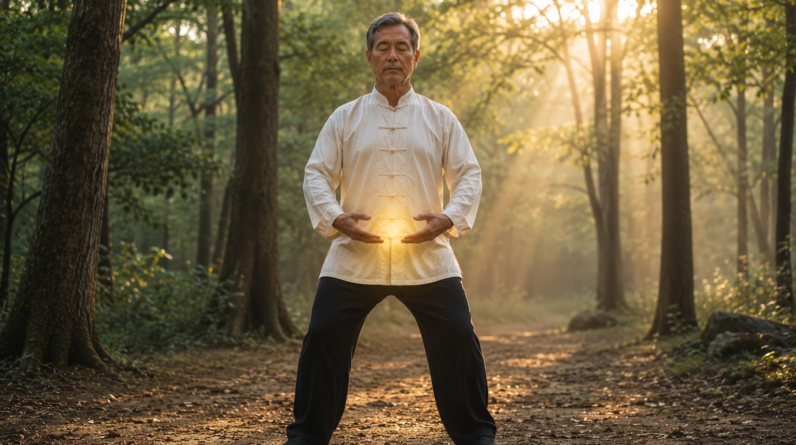
Many Tai Chi forms conclude with a simple movement often called Closing.
At first glance, it may seem unremarkable.
The hands return.
The body settles.
The movement comes to an end.
Yet this closing phase serves an important purpose.
It provides an opportunity to:
Gather attention.
Calm the breath.
Integrate the practice.
Return awareness to center.
Without a closing, the form can feel unfinished.
The return is what completes the cycle.
Completion Creates Integration
In modern culture, there is often pressure to move immediately to the next thing.
Finish one task.
Begin another.
Move faster.
Consume more.
But meaningful growth often requires a pause.
A moment of integration.
A chance to absorb what has been learned.
The closing movements of Tai Chi remind us that completion is not wasted time.
It is part of the practice itself.
Returning to Center
Whether through movement, meditation, breathwork, or daily life, there is value in returning.
Returning to the breath.
Returning to the body.
Returning to the present moment.
The goal is not to stay still forever.
The goal is to remember where center is.
From that place, movement becomes clearer.
Decisions become simpler.
The next step emerges naturally.
A Simple Reflection
At the end of your day, before moving on to the next task, pause for a moment.
Take a slow breath.
Notice where your attention is.
Notice how your body feels.
Allow yourself a brief return to center.
Like the closing movement of a Tai Chi form, the pause may be simple.
But it can be surprisingly powerful.
If you’d like to explore these principles through guided, fully seated Tai Chi and Qigong practice, you can learn more through Seated Chi Flow™.