In many areas of life, progress is often associated with doing more.
More movement.
More variation.
More complexity.
In Tai Chi and Qigong, the opposite is often true.
Progress comes from refinement.
The Value of Staying with One Movement
In traditional training, it is common to practice a single movement repeatedly.
At first, this may seem too simple.
But repetition, when combined with awareness, reveals depth.
The movement itself does not change.
But your experience of it begins to evolve.
You may start to notice:
The softening of the wrists.
The release of unnecessary tension in the shoulders.
The alignment of the spine.
The subtle coordination between breath and motion.
Each repetition becomes an opportunity to refine a different aspect.
Over time, these small refinements accumulate.
From Repetition to Flow
As the body begins to relax and coordinate, a new quality can emerge:
Flow.
Flow is not something that can be forced.
It develops when movement becomes continuous.
There are no abrupt starts or stops.
No sharp edges.
Instead, motion feels connected — one moment naturally leading into the next.
Circular patterns play an important role here.
They allow energy to expand and return without interruption.
This continuity is what gives Tai Chi its distinctive quality.
Less Movement, More Awareness
Single-form training invites a shift in perspective.
Rather than trying to learn more movements, we begin to understand one movement more deeply.
This often leads to:
Greater sensitivity
Reduced tension
Improved coordination
A clearer connection between breath and body
Even simple movements can become complete practices when approached in this way.
A Simple Practice
Choose one gentle movement.
Move slowly.
Repeat it several times.
With each repetition, bring your attention to a different aspect:
Breath.
Relaxation.
Continuity.
Notice how the movement begins to change — not externally, but in how it feels.
This is where refinement begins.
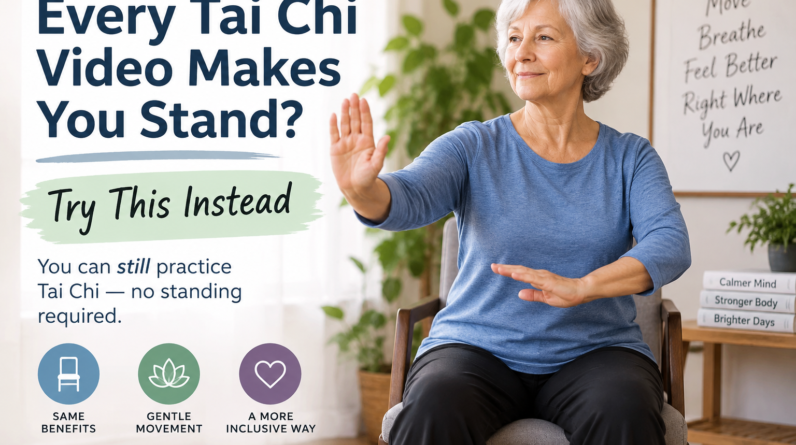
If you’d like to explore this approach through guided, fully seated practice, you can learn more through Seated Chi Flow™.