One of the beautiful things about Tai Chi is that the deeper you go, the simpler it becomes.
At first, we naturally focus on learning the movements.
Where does the hand go?
Which foot steps first?
Am I doing this correctly?
Those are important questions, especially for beginners.
But if we never move beyond them, we may miss one of the greatest gifts Tai Chi has to offer.
Recently I watched a thought-provoking video by Dr. Symeon Rodger in which he suggests that one of the biggest obstacles for many Western practitioners is the belief that mastering Tai Chi means reproducing the external form as perfectly as possible. His observation resonated strongly with my own experience as both a student and teacher.
The Form Is a Tool, Not the Destination
Most of us learn Tai Chi by copying.
We imitate the instructor.
We memorize the sequence.
We try to make our movements look like theirs.
That process has real value.
The form teaches structure.
It develops coordination.
It introduces the principles that underlie the art.
But the form is not the final destination.
It is a vehicle.
A container.
As Dr. Rodger explains, the purpose of Tai Chi and Qigong is not external perfection, but mind-body integration. The movements exist to develop awareness—not simply to produce beautiful choreography.
The movements are designed to help us develop awareness.
Awareness of the body.
Awareness of the breath.
Awareness of posture.
Awareness of balance.
Awareness of the subtle relationship between intention and movement.
And eventually…
Awareness of chi.
When our attention becomes consumed with external perfection, we can lose sight of the very qualities the form was designed to cultivate.
The Missing Dimension: Awareness of Chi
There is one more piece that has become increasingly important to me through my own studies with Master Waysun Liao.
Master Liao frequently reminds students that the purpose of Tai Chi is not simply to coordinate the body and the mind.
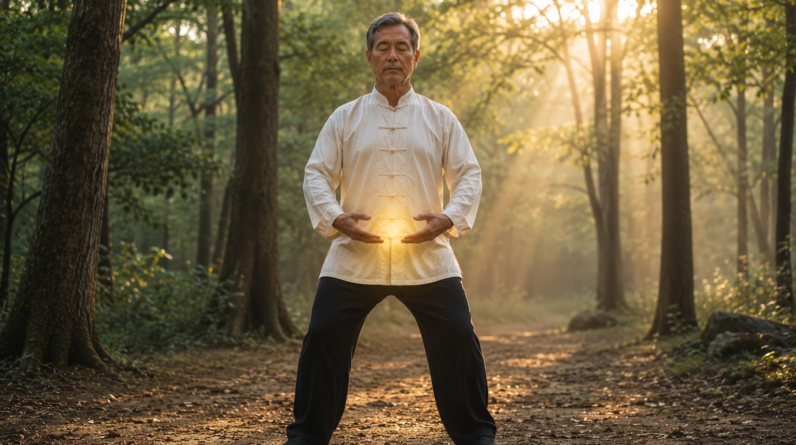
It is to become aware of chi—our internal life energy.
This isn’t something that can be learned by memorizing choreography alone.
You begin to notice it when the body relaxes.
When the breathing becomes natural.
When unnecessary muscular effort falls away.
As awareness deepens, many practitioners begin noticing subtle sensations they may never have paid attention to before.
Warmth.
Heaviness.
Fullness.
Gentle tingling.
A feeling of connection from the feet…
through the legs…
through the torso…
and into the fingertips.
These experiences cannot be manufactured.
Nor can they be fully explained by someone standing beside you adjusting your elbow another inch higher.
They arise through practice.
Through attention.
Through direct experience.
This is one reason Master Liao often encourages students to “listen” with the body.
Not merely to perform a movement…
but to experience it from the inside.
The Container and the Essence
One of my favorite ideas from Dr. Rodger’s presentation is the distinction between the container and the essence.
The form is the container.
The internal experience is the essence.
Imagine receiving a beautifully wrapped gift.
The wrapping matters.
It protects what’s inside.
It makes the gift recognizable.
But eventually you open the package because what you really want is the gift itself.
Tai Chi forms work in much the same way.
The external choreography gives us a framework.
Within that framework we begin discovering something far more important:
Relaxation.
Connection.
Breathing.
Rooting.
Flow.
Presence.
Awareness of chi.
Those are the qualities that remain valuable even after you’ve forgotten the name of a movement.
Why No Two People Move Exactly the Same
One of the reasons I appreciate this perspective is that it frees us from an impossible standard.
No two people have identical bodies.
We have different proportions.
Different flexibility.
Different injuries.
Different life experiences.
Even among highly skilled masters, movements vary slightly.
What remains consistent are the underlying principles.
The external form may look a little different.
The internal qualities remain remarkably similar.
The purpose is not uniformity.
It is authenticity.
This Is Why I Teach the Way I Do
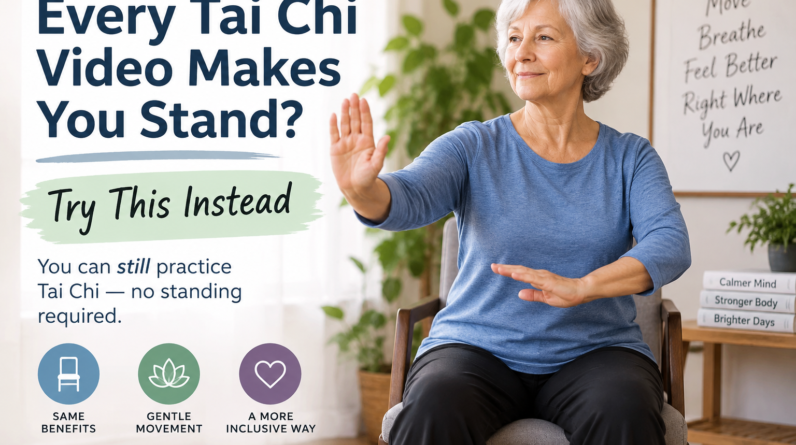
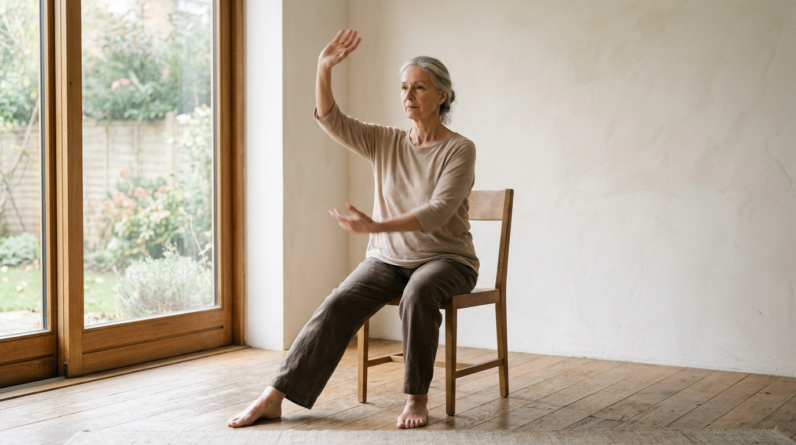
If you’ve practiced with me through Seated Chi Flow or my Tai Chi and Qigong classes, you’ve probably noticed that I often say things like:
“Stay within a comfortable range of motion.”
“Let your breathing determine the pace.”
“Move gently.”
“Don’t worry about making it perfect.”
“Feel the energy between your hands.”
“Notice the whole body working together.”
That isn’t lowering the standard.
It’s changing the standard.
The goal isn’t to make everyone look identical.
The goal is to help each person develop greater awareness within their own body.
For one student, success may be a larger range of motion.
For another, it may simply be noticing unnecessary tension in the shoulders.
For another, it may be the first unmistakable awareness of energy flowing through the body.
All are meaningful progress.
The Real Practice
One suggestion from Dr. Rodger particularly stood out to me.
Occasionally, he recommends stepping away from the formal choreography altogether.
Begin with an opening posture.
Then allow your body to move naturally.
Explore.
Notice.
Play with the breath.
Pay attention to what feels connected and what feels forced.
That doesn’t mean abandoning the forms.
Quite the opposite.
It means using the forms as they were intended—as teachers rather than rules.
Afterward, return to the form.
You’ll often discover that it feels different because you have changed.
Beyond the Form
The longer I practice Tai Chi, the less interested I become in performing movements that simply look correct.
Instead, I find myself asking different questions.
Am I relaxed?
Am I connected from the ground through the whole body?
Is my breathing natural?
Can I feel the movement of energy rather than merely perform the movement of muscles?
Those questions have changed my practice far more than trying to perfect another posture.
The forms remain important.
They give us structure.
They preserve centuries of wisdom.
But ultimately they are pointing toward something deeper.
Not perfect choreography.
Not external appearance.
But living awareness.
Awareness of the body.
Awareness of the breath.
Awareness of the mind.
And, perhaps most importantly…
Awareness of chi itself.
When that awareness begins to awaken, the forms are no longer something we simply perform.
They become something we experience from the inside out.
The Journey Never Ends
Perhaps this is why Tai Chi can be practiced for a lifetime.
In the beginning, we learn the movements.
Later, we begin to understand the principles behind them.
Eventually, we stop trying to make the movements happen and instead allow the movements to teach us.
The form becomes less about imitation and more about discovery.
Less about performance and more about presence.
Less about perfection and more about awareness.
And in that awareness, we discover that the greatest teacher has been within us all along.