Balance and Coordination in Tai Chi
When many people think about balance, they imagine stillness.
Standing perfectly upright.
Holding a position without wobbling.
But in Tai Chi, balance is often something more dynamic.
It is not only about remaining still.
It is about maintaining connection and coordination while the body continues to move.
Movement as Relationship
Tai Chi movements are rarely isolated.
The hands do not act alone.
The legs do not move independently.
The torso, breath, posture, and awareness all participate together.
As practice develops, movement becomes less about controlling individual body parts and more about allowing the body to function as one connected system.
This is especially noticeable in movements such as:
Golden Rooster Stands on One Leg
and
Kick with the Heel
Golden Rooster Stands on One Leg
Despite the name, this movement is not simply about balancing on one leg.
The movement also develops:
Coordination between upper and lower body
Smooth transitions from side to side
Awareness of timing and structure
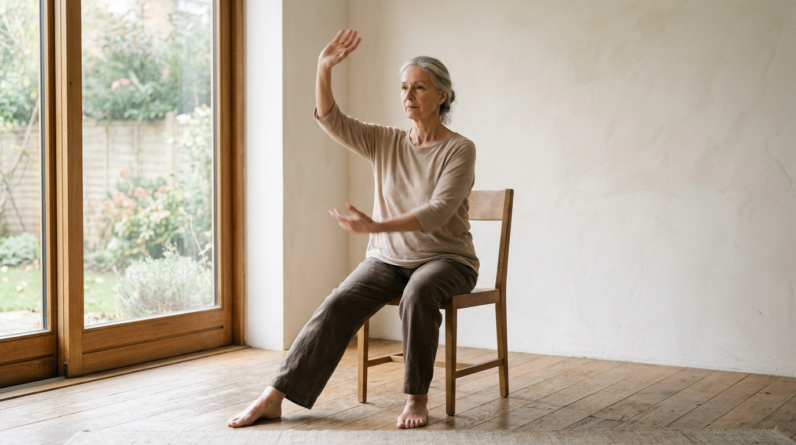
One hand rises while the other lowers.
At the same time, the knee gently lifts, following the elbow of the same side.
The movement alternates rhythmically between sides.
In seated practice, the foot may remain lightly connected to the floor or lift completely.
Either approach can help cultivate a sense of coordinated balance.
Kick with the Heel
This movement introduces another important Tai Chi principle:
Opposing yet connected actions.
As one heel extends outward, one hand moves forward while the other moves back.
The body organizes itself through complementary motion.
Rather than forcing the kick, the movement is approached with softness and continuity.
Even a small movement can help develop awareness of timing, rhythm, and integration.
Relaxation and Coordination
One of the interesting qualities of Tai Chi is that coordination improves not through tension, but through relaxation.
When the shoulders soften…
When the wrists remain loose…
When breathing stays natural…
Movement often becomes smoother automatically.
This is one reason Tai Chi can feel very different from exercises based primarily on muscular effort.
Small Movements, Meaningful Change
In seated Tai Chi practice, movements are often simplified and adapted.
But the underlying principles remain the same.
Connection.
Continuity.
Balance.
Coordination.
Even small movements can help retrain patterns of tension and encourage more natural movement throughout the body.
Over time, the body learns to move more efficiently and with less unnecessary effort.
A Different Experience of Balance
Balance in Tai Chi is not rigid control.
It is responsiveness.
The ability to remain connected while movement continues.
This quality develops gradually through relaxed repetition and steady attention.
Little by little, movement becomes less fragmented and more unified.
Not forced.
But integrated.
If you’d like to explore these ideas through guided, fully seated practice, you can learn more through Seated Chi Flow™.