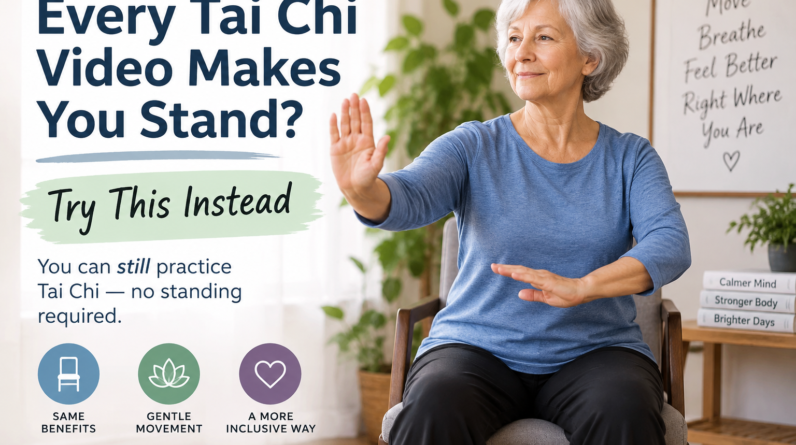
What if seated movement weren’t a modified version of something else, but a complete practice in its own right?
If you’ve been exploring chair exercise programs, you may have noticed something interesting: not every program approaches seated movement in the same way.
Some begin with exercises traditionally performed while standing, then offer a seated alternative. Others are developed specifically around the experience of moving while sitting.
Both approaches have their place. But if you’re looking for a practice that feels natural, intentional, and complete while seated, that distinction may matter more than you initially realize.
It’s worth asking a simple question:
Was this exercise designed for someone sitting in a chair, or was it designed for someone standing up?
The answer could change the way you choose your next movement program.
The Difference Between Modified Exercise and Seated-First Movement
Imagine watching an exercise instructor demonstrate a standing movement.
The instructor shifts weight from one foot to another, steps forward, turns, and reaches. Then comes the seated alternative: remain in your chair and perform the arm movements.
That modification may be useful. It gives participants another way to engage with the exercise.
But the experience isn’t necessarily the same.
When a movement is originally designed around standing, stepping, or transferring weight between the legs, removing those elements changes its structure.
A seated modification must determine which parts of the original movement can be retained and which need to be adjusted.
A seated-first practice begins somewhere else entirely.
Rather than asking, “How can we change this standing exercise so someone can do it sitting down?” it asks:
“What movements can we create and explore while remaining comfortably seated?”
That difference is more than a matter of convenience. It’s a different starting point for instruction.
For someone specifically searching for seated exercise, it may also be an important consideration when choosing a program.
Your Chair Doesn’t Have to Be a Backup Plan
There’s a subtle message that can accompany modified exercise: the standing version is the original, and the seated version is the alternative.
That isn’t necessarily the instructor’s intention. Modifications can make movement accessible to more participants, and that’s valuable.
Still, some people would prefer not to approach their exercise practice as an adaptation of something they aren’t doing.
They want to sit down, follow the instructor, and know that the practice was created with their position in mind.
They don’t want to wonder whether they’re missing an essential part of the routine because they aren’t standing.
And they don’t necessarily want an explanation of how to perform the standing version first.
They want instruction that begins where they are.
This is where intentionally seated movement offers a different perspective.
The chair isn’t an accommodation added to the practice. The chair is part of the practice from the beginning.
That idea is at the heart of Seated Chi Flow™.
Introducing Seated Chi Flow™: Tai Chi and Qigong Designed for Sitting
Seated Chi Flow™ is a guided movement program built around the principles of Tai Chi and Qigong.
Unlike programs that begin with standing routines and then introduce chair modifications, Seated Chi Flow is designed to be performed entirely while seated.
There are no standing exercises to complete.
There are no floor exercises to transition into.
And there is no expectation that participants will eventually move beyond the chair to experience the intended practice.
Seated participation is the intended practice.
The program combines gentle, controlled movements with mindful breathing, drawing from the traditions of Tai Chi and Qigong.
These practices emphasize awareness, coordination, and the relationship between breathing and movement.
Seated Chi Flow brings those elements into a format developed for people who want to participate from a chair.
For someone exploring seated movement options, this offers a clear distinction: you’re not signing up for a standing exercise program that happens to include seated alternatives.
You’re exploring a program designed around seated movement itself.
Learn more at https://SeatedChiFlow.com.
Why Tai Chi and Qigong Are Worth Exploring
Tai Chi and Qigong are often associated with slow, deliberate movement, attention to posture, and awareness of breathing.
Rather than focusing on speed or vigorous repetition, these practices invite participants to pay attention to the quality of movement.
A gentle reach can become an opportunity to notice how the shoulders and arms move.
A slow turning movement can encourage awareness of the torso.
Coordinating movement with natural breathing can become a way to bring attention to the present moment.
These are elements that can be explored without turning exercise into a demanding physical performance.
And importantly, they don’t require every participant to move in precisely the same way.
Seated Chi Flow uses these principles in guided routines intended for seated participation.
The program presents gentle movement as an approachable practice rather than an intense workout.
It is designed to support interests such as comfortable mobility, relaxation, and movement awareness, without promising particular medical or physical outcomes.
For someone seeking a quieter, more mindful approach to movement, the combination may be appealing.
What to Look for When Choosing a Seated Exercise Program
If you’re comparing chair exercise options, consider looking beyond the label “seated.”
A program can include chair exercises without being designed primarily for seated participation.
Here are several useful questions to ask before choosing.
1. Is Every Movement Intended to Be Performed While Seated?
This may be the most important question if standing exercise isn’t an option you want to consider.
Some programs include a combination of seated and standing routines. Others provide seated modifications alongside traditional instruction.
Seated Chi Flow is designed to be fully seated throughout.
2. Does the Instructor Teach From a Seated Perspective?
There’s a difference between watching someone demonstrate a standing exercise and being guided through a movement intended for a seated participant.
Consider whether the instruction explains the seated practice itself, rather than simply telling you which parts of a standing exercise to omit.
3. Does the Program Offer a Manageable Starting Point?
An appealing movement practice should also fit the amount of time you want to devote to it.
Seated Chi Flow routines are generally about 10 minutes long, providing an approachable format for exploring gentle movement and breathing.
4. Can You Practice at Your Own Pace?
Not everyone wants to follow a fixed class schedule.
Seated Chi Flow provides guided videos that participants can follow at home, with access to previous sessions through Substack.
This makes it possible to return to the material at a personally convenient time.
5. What Kind of Guidance Comes With the Program?
Some people prefer more than a video demonstration.
Seated Chi Flow includes one-page PDF companions with movement cues, breathing reminders, and safety notes.
These materials provide additional reference points alongside the guided routines.
Taken together, these questions can help you identify a program that matches not only your interest in seated exercise, but also the kind of instruction you want to receive.
A Simple Way to Begin
One appealing aspect of a fully seated practice is the simplicity of getting started.
With Seated Chi Flow, you don’t need specialized exercise equipment.
A chair is all that’s required.
The program is beginner-friendly, and its short guided routines introduce gentle movement and mindful breathing without requiring previous Tai Chi or Qigong experience.
A getting-started video provides an introduction to the program.
From there, subscribers receive new guided routines each week, accompanied by PDF reference materials.
Membership also includes quarterly guided group sessions, with replays available for those who cannot attend live.
This combination of ongoing instruction and access to previous material gives participants several ways to engage with the practice.
There is no requirement to attend every session live or keep pace with a traditional class.
The focus remains on accessible, fully seated participation.
What Does Seated Chi Flow Membership Include?
Seated Chi Flow is offered through a subscription with two payment options:
- $9 per month
- $79 per year
The annual option saves $29 compared with paying the monthly rate for 12 months.
Membership includes weekly guided seated Tai Chi and Qigong videos, one-page PDF companions, quarterly group sessions and replays, and access to previous sessions through Substack.
Subscriptions can be canceled, subject to the applicable subscription terms.
The program is intended for gentle movement and general wellness, not as a replacement for individualized medical advice or treatment.
For someone who wants ongoing guidance rather than an isolated exercise demonstration, the subscription provides a structured source of new seated practice material.
Seated Movement Deserves to Be More Than an Afterthought
There is nothing inherently wrong with modifying a standing exercise.
Adaptations can be useful, practical, and appropriate for many people.
But choosing a seated program doesn’t have to mean accepting a modified version of something else.
You can look for instruction that begins with the chair, respects seated movement as a complete approach, and offers a thoughtful way to explore gentle physical activity.
That is the idea behind Seated Chi Flow™.
It isn’t about recreating a standing Tai Chi class while sitting down.
It’s about exploring Tai Chi and Qigong principles through movements intentionally designed for seated participation.
The seated practice isn’t the alternative. It’s the practice.
If you’ve been searching for chair exercise that feels purposefully designed rather than adapted, Seated Chi Flow may be worth exploring.
Discover the program, see what membership includes, and decide whether this approach fits what you’re looking for.
Explore Seated Chi Flow™ at https://SeatedChiFlow.com
Gentle movement. Mindful breathing. Fully seated from the beginning.