In Tai Chi, simple movements are often anything but simple.
A movement that appears easy on the surface can reveal increasing depth over time through repetition, attention, and refinement.
This is especially true when beginning a traditional form.
The Purpose of a Form
A Tai Chi form is a sequence of connected movements practiced in a continuous flow.
Different styles contain different forms — some short and compact, others long and highly detailed.
The Yang Simplified 8 Form is a shorter sequence built from foundational Yang Family Tai Chi movements.
Because of its simplicity, it offers an excellent opportunity to focus on core principles without becoming overwhelmed by complexity.
Beginning with the Basics
The preparatory movement in the sequence is often called Upward and Downward or the Commencement Form.
At first glance, it may appear to be a simple lifting and lowering of the arms.
But over time, subtler qualities begin to emerge:
The coordination of breath and motion.
The relationship between expansion and return.
The feeling of the whole body participating in the movement.
Rather than lifting only with the arms, the movement begins to feel supported from the center of the body.
The Energy Ball
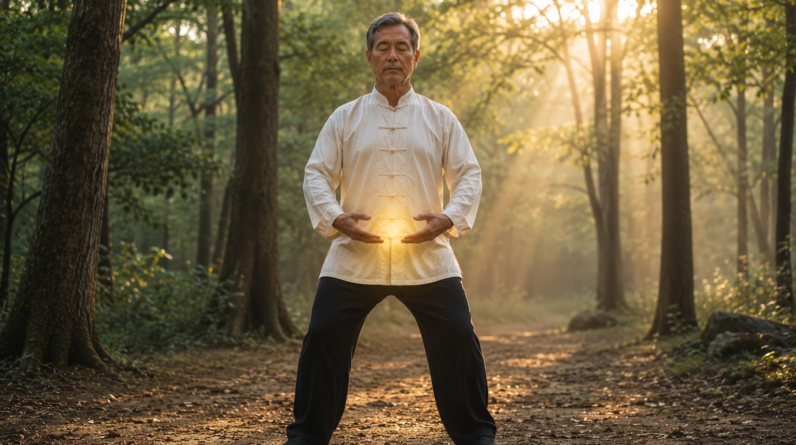
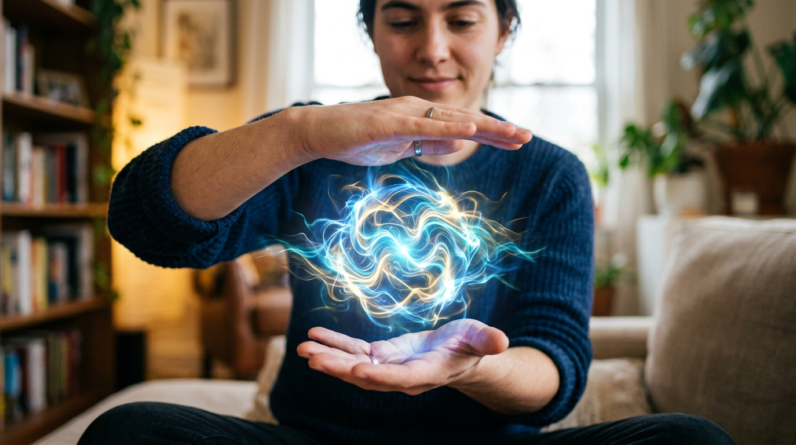
A common training method in Tai Chi and Qigong involves imagining an “energy ball” between the hands. An opportunity to train this method arises within the official first movement, Repulse Monkey.
This visualization helps develop:
Awareness of spacing
Softness in the wrists and fingers
Continuity of movement
Sensitivity to circular motion and to our body’s energy
The goal is not to force an experience, but to encourage relaxed attention.
As the hands move, the awareness between them remains continuous.
Brush Knee and Push
The second movement, Brush Knee and Push, introduces additional coordination.
One hand brushes downward past the knee while the other rises and extends forward.
Although the movement has martial origins, in practice the emphasis is often placed on:
Relaxation
Alignment
Whole-body integration
Continuous flow
The movement should feel connected rather than segmented.
There is no abrupt stopping point.
One action transitions naturally into the next.
Repetition Creates Familiarity
When learning a new form, it is easy to focus too heavily on memorization.
But Tai Chi develops differently than many other physical disciplines.
Progress often comes through relaxed repetition.
The body gradually becomes more familiar with the shapes, timing, and coordination.
What once felt awkward begins to feel natural.
Over time, the movements become less mechanical and more fluid.
A Different Kind of Learning
Tai Chi is not simply about collecting techniques.
It is about refining awareness through movement.
Even a single movement can continue revealing new layers over years of practice.
This is one reason traditional systems often emphasize simplicity and repetition rather than constant variation.
Depth develops slowly.
But it develops steadily.
If you’d like to explore these ideas through guided, fully seated practice, you can learn more through Seated Chi Flow™.