There’s a moment—usually quiet, subtle—when something shifts in your body during Qigong.
Your shoulders drop without effort. Your breath deepens on its own. A gentle warmth or tingling begins to move, almost as if your body remembers something your mind forgot.
Most people chase that feeling.
But what if the key isn’t more effort… more precision… or even more practice?
What if the real key is something you already had—effortlessly—as a child?
What Is Qigong Imagination? (And Why It Rewires the Body So Quickly)
Core Entities: Qigong, imagination, Yi (intent), nervous system, energy flow (Qi), somatic awareness
Qigong imagination is not “pretending.” It is the deliberate use of mind-intent (Yi) to guide internal experience—breath, sensation, and movement—so the body reorganizes itself naturally.
In traditional Qigong theory:
Yi leads Qi. Qi moves the body.
In modern language:
Your attention + imagery directly influences your nervous system, muscle tone, and internal perception.
Why This Works (Science + Experience Layered Together)
- The brain activates similar pathways for imagined and real movement
- The nervous system responds to felt meaning, not just physical action
- Imagination enhances interoception (your ability to feel inside your body)
👉 This is why simply imagining warmth in your hands can literally make them feel warmer.
The Childlike State: The Missing Link in Most Qigong Practice
Core Entities: childlike awareness, play, curiosity, relaxation, flow state, mindfulness
Children don’t try to feel.
They experience directly.
They don’t analyze whether something is “working.”
They immerse themselves in it.
This state includes:
- Curiosity instead of judgment
- Playfulness instead of performance
- Relaxation instead of control
See It in Action (Guided Visualization Example)
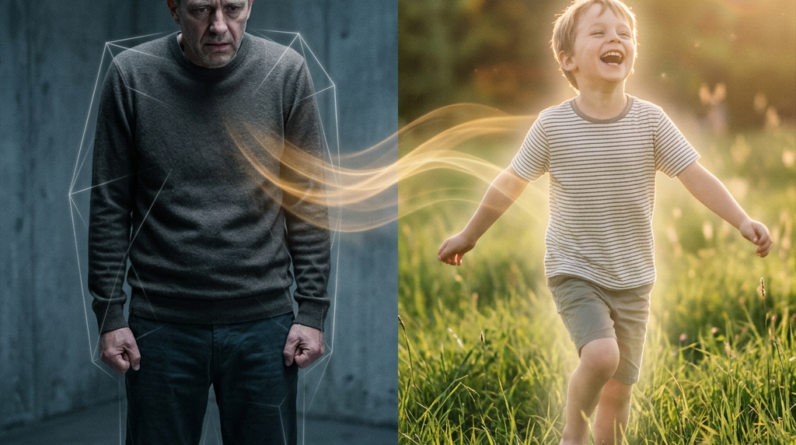
Here’s a short guided experience that brings this concept to life. In this video, you’re invited to visualize yourself as a 7-year-old child running barefoot in the grass—free, playful, and full of energy:
Notice how quickly your body responds—not because you forced anything, but because you remembered how to feel.
Also see:
How Imagination Unlocks Healing Energy Flow (Step-by-Step Mechanism)
Entity Cluster: breath regulation, fascia, circulation, parasympathetic activation, emotional release
Let’s connect the dots clearly:
- You imagine a sensation (e.g., warmth, expansion)
- The brain interprets it as meaningful input
- The nervous system shifts toward relaxation
- Muscles release unnecessary tension
- Circulation improves
- Sensation increases → reinforcing awareness
This creates a feedback loop:
Imagination → sensation → relaxation → stronger sensation → deeper flow
That loop is what practitioners describe as Qi flow.
4 Childlike Qigong Imagination Techniques for Healing Energy Flow
These are not abstract ideas. These are direct-access tools.
1. The Floating Body Technique (Effortless Release)
Imagery: You are gently floating in warm water
- Feel your weight dissolving
- Let joints soften without forcing
- Allow the body to “be held”
Effect:
Reduces muscular tension → improves whole-body flow
2. Golden Light Filling the Body (Healing + Warmth)
Imagery: Warm sunlight slowly filling your body from head to toe
- Move attention gradually downward
- Pause in areas of tightness
- Let the warmth “linger”
Effect:
Enhances circulation + creates localized awareness
3. Balloon Breathing (Expansion + Internal Space)
Imagery: Your abdomen expands like a soft balloon
- Inhale: gentle expansion
- Exhale: natural release
- No forcing—just allowing
Effect:
Regulates breath + activates parasympathetic nervous system
4. Gentle Wave Motion (Natural Energy Circulation)
Imagery: A soft wave moving through your body
- Start at the feet or hands
- Let it travel slowly upward
- Follow—not control—the motion
Effect:
Restores fluid, connected movement patterns
How to Feel Energy Flow for the First Time (What to Look For)
Core Entities: tingling, warmth, heaviness, lightness, internal movement
Many people expect something dramatic.
In reality, the first signs are subtle:
- A gentle tingling in the hands or feet
- A feeling of warmth spreading
- A sense of soft heaviness or groundedness
- Movement that feels effortless rather than controlled
👉 If you notice any of these, you’re already doing it correctly.
Common Blocks (And How to Instantly Fix Them)
1. “I’m Not Feeling Anything”
- Fix: Reduce effort by 30%
- Shift from doing → noticing
2. Overthinking the Process
- Fix: Use simpler imagery (light, water, breath)
- Stay with one sensation longer
3. Trying to Force Results
- Fix: Return to a childlike mindset
- Ask: “What happens if I just let this unfold?”
A 5-Minute Daily Qigong Imagination Practice (Beginner Protocol)
Schema-Ready Structure (Step-Based Featured Snippet Target)
- Stand or sit comfortably
- Relax shoulders and jaw
- Begin slow, natural breathing
- Choose ONE imagination technique
- Stay with it for 3–5 minutes
- Notice sensations without judging
- End by standing quietly for 30 seconds
👉 Consistency matters more than duration.
A Gentle Path for Seated Practice (Accessible for Every Body)
One of the most powerful aspects of imagination-based Qigong is that it does not require standing, flexibility, or complex choreography.
In fact, many practitioners discover deeper internal flow when practicing fully seated, because:
- The body can relax more completely
- Balance is no longer a distraction
- Attention naturally turns inward
If you’re interested in exploring this approach more deeply, you might enjoy a fully guided, structured system like Seated Chi Flow™, which focuses on:
- Gentle, fully seated Tai Chi and Qigong movements
- Breath-led energy activation
- Imagination-based techniques just like the ones in this article
It’s designed especially for adults who want a calm, accessible, and effective daily practice—whether for relaxation, mobility, or energy flow.
👉 You can explore it here: https://SeatedChiFlow.com
Emotional Energy and the Body: Why This Feels Like Healing
Entity Cluster: emotional release, stress reduction, trauma-informed movement, relaxation response
Stored tension is often emotional as much as physical.
When you use imagination:
- You create a sense of safety
- The body releases held patterns
- Breath becomes more natural
- Movement becomes more fluid
This is why many people report:
- Reduced stress
- Improved mood
- Greater clarity
- A sense of “coming back to themselves”
From Practice to Lifestyle: Living in a State of Flow
The real transformation isn’t just during practice.
It’s when:
- Walking feels lighter
- Breathing feels deeper
- Movements feel connected
- Your body responds instead of resists
That’s when Qigong stops being something you do…
and becomes something you live.
FAQ: High-Intent Search Reinforcement
Can imagination really create energy flow in Qigong?
Yes. Both traditional Qigong theory (Yi leads Qi) and modern neuroscience confirm that attention and imagery influence physical sensation, relaxation, and internal awareness.
What if I can’t visualize clearly?
Visualization is not required. Focus on feeling (warmth, expansion, softness) instead of seeing images.
How long does it take to feel results?
Many people notice subtle sensations within minutes when they reduce effort and engage imagination properly.
Is this suitable for beginners or older adults?
Yes. In fact, imagination-based Qigong is often easier and more effective for beginners and those practicing gentle or seated forms.
The Real Secret (Closing the Loop)
The deeper truth is simple—and easy to overlook:
You don’t need to become someone new to experience energy flow.
You need to return to something you already were.
Curious. Relaxed. Open.
Childlike.
And when you do…
your body remembers exactly what to do.