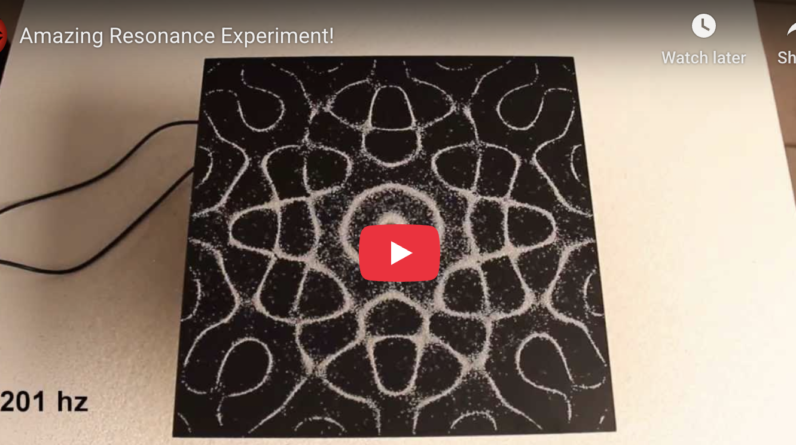
One of the most striking demonstrations of how sound shapes matter appears in the YouTube video Amazing Resonance Experiment!.
In the video, a metal plate is vibrated at different frequencies while sand rests on its surface. As the pitch changes, the sand rearranges itself into precise, symmetrical geometric patterns. Each frequency produces a different form. When the frequency shifts again, the pattern dissolves—and a new one emerges.
What we’re witnessing is resonance made visible.
Sound is not just something we hear. It is organized vibration, capable of shaping structure.
This simple experiment quietly points to a much larger truth—one that music, internal martial arts, and healing traditions have recognized for centuries.
Sound as Organized Energy
From a scientific perspective, sound is vibration traveling through a medium. From a musical perspective, it is frequency organized into harmony. From an internal arts perspective, it is movement of energy through form.
These viewpoints aren’t contradictory. They’re complementary.
When vibration is coherent, it organizes.
When vibration is chaotic, structure breaks down.
That principle applies to metal plates… and to human beings.
Sound and Vibration in Qigong
In Spring Forest Qigong, sound vibration is taught as one of the four cornerstones of practice, alongside movement, breathing, and visualization.
Practitioners use specific healing sounds—not as metaphors, but as functional tools—to:
-
regulate internal energy
-
release stagnation
-
harmonize organ systems
-
support emotional balance
Here, sound is not performance. It is medicine.
The voice becomes a tuning fork for the body.
Tai Chi and the Healing Use of Sound
Certain Tai Chi systems also integrate sound, most famously through the paired internal sounds Heng and Ha.
These sounds are traditionally associated with:
-
releasing internal tension
-
coordinating breath and movement
-
activating deep internal power
-
regulating pressure and effort
But beyond martial application, Heng and Ha function as internal vibrational cues. They subtly influence posture, breath depth, and internal tone—much like changing the frequency in the resonance experiment changes the visible pattern.
Different sound → different internal organization.
The Body as a Resonant System
This brings us to healing.
If sound can organize sand into geometric form…
If vibration can shape metal plates into order…
What might it do inside a living, fluid, responsive human body?
This question has been explored not only by traditional practices, but also by modern medicine.
Sound, Music, and Healing in Medical Practice
In the book The Healing Power of Sound, oncologist Mitchell L. Gaynor, M.D., documents how he integrated sound, music, and vocalization into his medical practice with patients facing life-threatening illness.
Dr. Gaynor didn’t approach sound as an alternative belief system. He approached it as a therapeutic modality—one that could:
-
reduce stress responses
-
support emotional processing
-
enhance relaxation and recovery
-
improve overall quality of life during treatment
His work reinforces an idea long present in Eastern practices: healing is not only chemical or mechanical—it is vibrational.
A Shared Language Across Traditions
Seen together, these threads form a surprisingly unified picture:
-
Physics shows us that frequency creates form
-
Music demonstrates how vibration organizes emotion and attention
-
Qigong uses sound to regulate internal energy
-
Tai Chi uses sound to coordinate breath, structure, and intent
-
Medicine is rediscovering sound as a healing influence
Different languages. Same principle.
When vibration becomes coherent, systems reorganize toward balance.
Bringing It Back to Practice
Practices like Tai Chi and Qigong don’t need us to believe in vibration—they invite us to experience it.
A sound felt in the chest.
A hum that softens the abdomen.
A breath that settles the nervous system.
A movement that suddenly feels integrated instead of fragmented.
Just like in the resonance experiment, the shift isn’t forced.
It emerges.
This article includes an Amazon affiliate link. If you decide to purchase the book through that link, I may earn a small commission at no additional cost to you. This helps support the ongoing work of Five Element Harmony, and I only share resources I truly respect and recommend.